

Jemaa el-Fna square
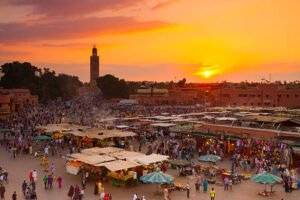
Jemaa el-Fna is the beating heart of Marrakech: a huge square where you will find everything, from local food stalls to snake charmers. You will cross it many times, as it links different parts of the city, and it is worth coming back at different times of day because it changes completely from day to night.
Our tip: watch the sunset from one of the terraces overlooking the square and see how it lights up and fills with food stalls as evening falls.
The souks
“Souk” means market. Marrakech’s has over eight centuries of history: desert tribes came here to sell their goods and drink tea. The shops are still grouped by trade: the dyers’ souk, the lamp souk, the silk and cotton souk…
Be prepared: in the souk you bargain and say “no, thank you” many times. Some find it tiring, but it can also be unforgettable: Moroccans are very hospitable and you may well be invited for tea.
A hammam
Going to a hammam is a quintessentially Moroccan experience. There are traditional hammams used by locals and others designed for visitors. In both, someone will literally wash you from head to toe with a scrubbing glove and black soap: you will come out feeling brand new.
The Koutoubia Mosque
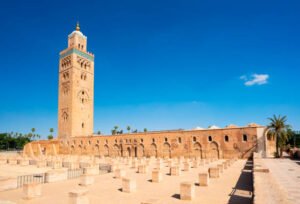
The Koutoubia minaret, about 77 metres tall, is the symbol of the city and can be seen from afar. The mosque, the most important in Marrakech, is not open to non-Muslims, but the gardens around it are lovely, especially at prayer time.
Ben Youssef madrasa
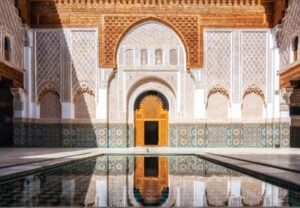
“Madrasa” means school. Ben Youssef, next to the mosque of the same name, is one of the largest in Morocco: founded in the 14th century and rebuilt in the 16th, it housed Koranic students for centuries. Today it is a museum and a masterpiece of Islamic architecture, with carved stucco, cedar wood and zellige.
The Almoravid Koubba
Next to the madrasa stands the 12th-century Almoravid Koubba, used for ablutions before prayer. It is one of the very few examples of Almoravid art left in the city.
Museums
The Marrakech Museum, near the madrasa, displays Moroccan art in a beautiful palace. Dar Si Said is devoted to crafts, and the Maison de la Photographie holds historic photographs of the city and the country.
The tanneries
Leatherwork is everywhere in Morocco. Near Bab Debbagh you can see how hides are tanned, a very hard job. The smell is strong. Around the tanneries many people will offer to show you round “for free” and then ask for a tip, so bear that in mind if you accept.
El Badi Palace
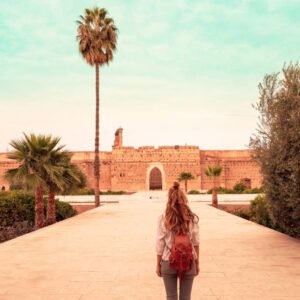
Built at the end of the 16th century by the Saadian sultan Ahmed al-Mansur, it was one of the most lavish palaces of its time. Today its massive walls, courtyards with pools and views from the terraces, where storks nest, remain.
Bahia Palace
A few minutes’ walk from El Badi, the Bahia Palace was built in the 19th century for the grand vizier Ba Ahmed. It was stripped of its furnishings after his death, but keeps its courtyards, painted ceilings and gardens: a superb example of Moroccan architecture.
Majorelle Garden
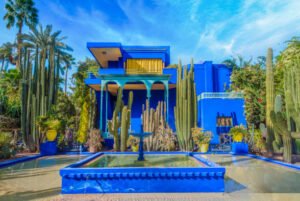
Outside the medina, the Majorelle Garden is considered by many the most beautiful in the city. It was created from 1924 by the French painter Jacques Majorelle and in 1980 was bought and saved by Yves Saint Laurent and Pierre Bergé. The intense blue buildings, plants from around the world and the Berber Museum inside make it unmissable. The Yves Saint Laurent Museum is next door.
Opening hours and ticket prices change often: check them before your visit.
Want to see Marrakech with a guide and continue to the desert? See our tours from Marrakech.
More about Marrakech on Wikipedia.
Keep reading
 2 min readGuided tour of MarrakechAn itinerary for a guided tour of Marrakech: Jemaa el-Fna, the medina and souks, the Koutoubia, Majorelle, Bahia Palace, the Saadian Tombs, El Badi.Read article →
 1 min readWhy travel to MarrakechWhy visit Marrakech: the medina and Jemaa el-Fna, the Koutoubia, the modern city's museums and restaurants, and day trips to Ourika.Read article →
 3 min readWhat makes Fes specialWhat to see in Fes, Morocco's oldest imperial city: the UNESCO medina, Al Qaraouiyine, the madrasas, the Chouara tanneries, Bab Boujloud and practical tips.Read article →