

Fes is one of Morocco’s oldest and most culturally rich cities. Founded in the 9th century, it was the capital under several dynasties and is still considered the cultural and spiritual heart of the country. Here is what makes it unique.
1. The medina of Fes (Fes el-Bali)
A maze of narrow alleys, squares and lively souks: one of the best-preserved medieval medinas in the world, a UNESCO World Heritage Site, explored only on foot. Don’t miss:
- The Bou Inania madrasa, a 14th-century Koranic school famous for its carved wood and mosaics.
- The souks, with spices, fabrics, ceramics, jewellery and leather goods.
2. Al Qaraouiyine University
Founded in 859, it is considered one of the oldest universities in the world still in operation. It is a symbol of Fes’s intellectual and religious heritage and its library holds historic manuscripts.
3. The el-Attarine madrasa
Built in the 14th century, it is a masterpiece of Islamic architecture, with fine details in wood, marble and zellige tiles.
4. The tanneries of Fes (Chouara)
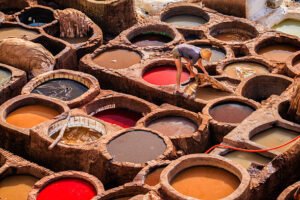
Among the oldest and most famous in the world: from the terraces you can watch leather being worked by traditional methods almost unchanged for centuries, with large vats of natural dyes. The smell is strong, but the sight is unique. Fes leather is famous throughout Morocco.
5. Al Qaraouiyine Mosque
Part of the university complex, it is one of Morocco’s most important places of worship. It is not open to non-Muslims, but you can glimpse the courtyard from the entrance.
6. Bab Boujloud
The Blue Gate, the medina’s most iconic entrance, known for its colourful tilework. It is the starting point for many visits.
7. Jnan Sbil Gardens
An oasis of calm near the medina, with shady paths, fountains and exotic plants: perfect for a break.
8. Fassi cuisine
Considered one of the most refined in Morocco: couscous, tagine, pastilla and pastries, with spices such as saffron, cinnamon and ginger.
9. Fes el-Jdid
“New Fes”, founded in the 13th century by the Marinids, is home to the Royal Palace with its golden gates, the Mellah (the Jewish quarter) and several gardens. The modern city lies beyond.
10. The spiritual atmosphere
For centuries Fes has been a centre of learning, spirituality and art, with mosques, Koranic schools and festivals such as the World Sacred Music Festival and the Sufi Culture Festival. Time seems to stand still here.
11. Crafts
Hand-woven rugs, painted ceramics, leather, carved wood, jewellery and textiles: the souks of Fes are known for the quality of their crafts.
12. Everyday life
Street sellers, craftsmen, laden donkeys and locals fill the alleys and squares. Walking through the medina feels like going back in time, in a city that is still very much alive, where history and modern life meet.
Tips for your visit
- Dress: Fes is fairly conservative, so dress modestly, especially near religious sites.
- A local guide: it is easy to get lost in the medina; a guide helps you find your way and explains the monuments.
- Bargaining: haggling is normal in the souks.
- On foot: cars cannot enter the medina and traffic outside can be chaotic.
In short
The medieval medina, the ancient university, the crafts and everyday life make Fes an essential stop to discover the essence of Morocco.
See our tours from Fes to the desert.
Keep reading
 3 min readWhat to see and do in MarrakechWhat to see in Marrakech: Jemaa el-Fna square, the souks, a hammam, the Koutoubia, Ben Youssef madrasa. We help you plan your trip.Read article →
 2 min readGuided tour of MarrakechAn itinerary for a guided tour of Marrakech: Jemaa el-Fna, the medina and souks, the Koutoubia, Majorelle, Bahia Palace, the Saadian Tombs, El Badi.Read article →
 1 min readWhy travel to MarrakechWhy visit Marrakech: the medina and Jemaa el-Fna, the Koutoubia, the modern city's museums and restaurants, and day trips to Ourika.Read article →